The “Green Sand” (Cat Xanh) Model: A solution to help enhance the effectiveness of associations, societies, clubs, and groups.
FROM BUSINESS ASSOCIATIONS AND CLUBS TO AN ECOSYSTEM OF OPPORTUNITIES
Over the years, alongside the growth of the private sector, Vietnam has seen the emergence of numerous business associations, entrepreneur clubs, startup communities, and business networking groups. This is a positive development, as entrepreneurs require not only capital and knowledge but also connections, partners, customers, collaborators, and an environment for mutual growth.
However, a large membership base does not necessarily equate to a robust ecosystem.
An association may boast hundreds of members, yet few truly support one another. A club might organize frequent events, but once they conclude, members often return to the same old challenges: a lack of customers or cash flow, difficulties in recruitment and management, limited access to capital, legal hurdles, or uncertainty about whom to turn to for a specific project.
The issue, therefore, is not the number of members, events, or high-profile speakers.
The more critical question is: what value does each member derive from the community, and how many tangible opportunities does the community generate for its members?
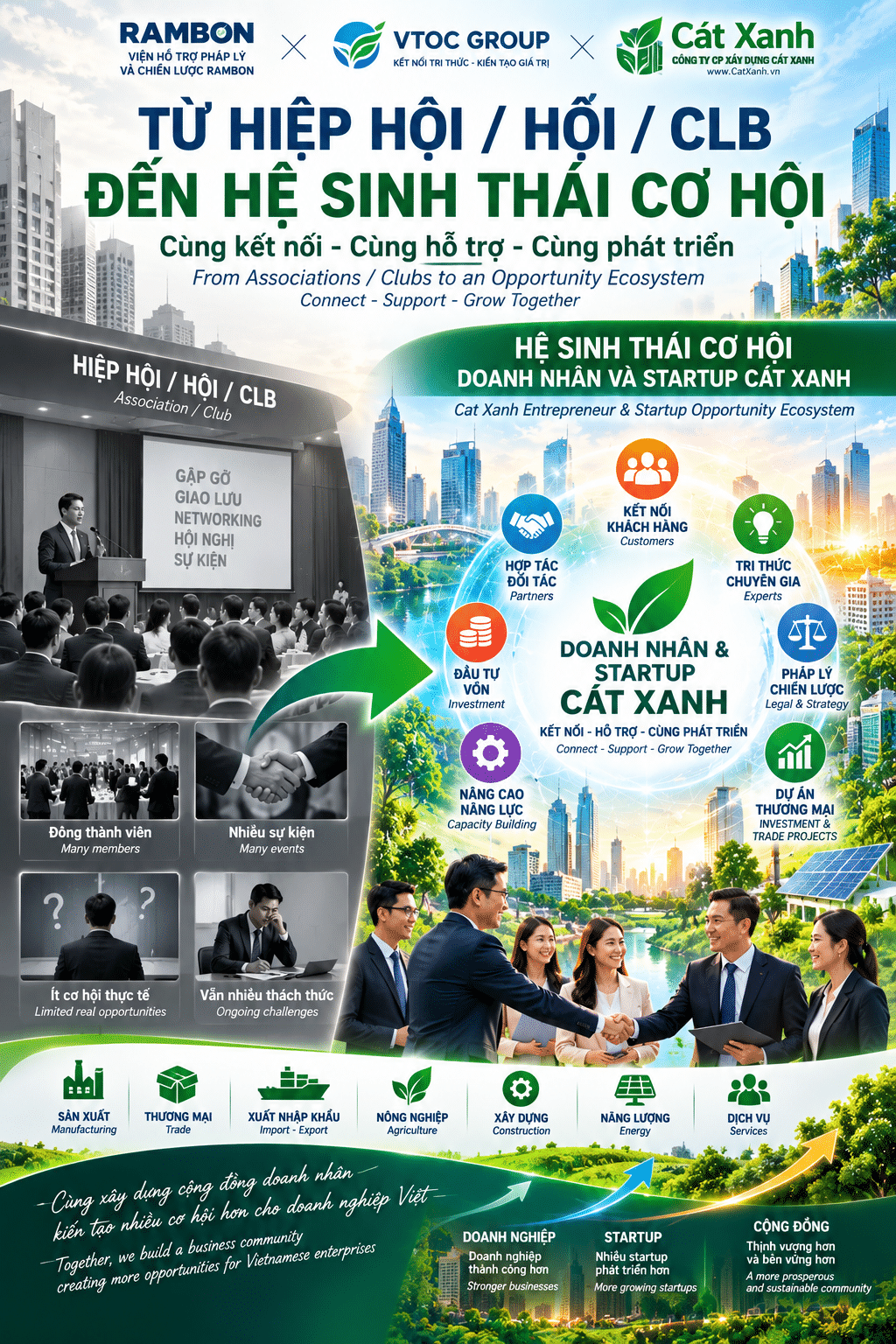
This question also laid the foundation for the “Green Sand Entrepreneurs and Startups” model, researched and developed by the RAMBON Institute for Legal and Strategic Support in collaboration with VTOC Group. The initiative aims to pilot a different approach: moving beyond a mere networking club to build an ecosystem of opportunities, support, and mutual growth.
When “having a community” does not equate to “having an ecosystem”
A typical entrepreneurial community often originates from a valid need: bringing businesspeople together to socialize, learn, and network.
However, over time, the community’s activities may increasingly revolve around membership numbers, meetings, conferences, galas, social mixers, business cards, titles, and image-building exercises.
These activities are not without value. The issue arises when the activities themselves become the goal, rather than a means to create value.
A networking event might help two entrepreneurs get to know each other. Yet, familiarity does not imply trust; trust does not guarantee collaboration; and collaboration does not necessarily generate revenue.
The gap between “meeting” and “co-creating value” is precisely the void that many communities have yet to address systematically.
A genuine entrepreneurial ecosystem must go beyond merely introducing members to one another. It needs to establish mechanisms whereby a need is identified, the right person is introduced, a meeting is arranged, and an opportunity is pursued—ultimately leading to contracts, projects, revenue, or long-term partnerships.
In other words, networking is merely the starting point; it is the *opportunity* itself that must be created.

The presence of famous figures does not guarantee a strong community
A common strategy is to invite renowned entrepreneurs, prominent experts, or leaders from major corporations to generate interest and draw a crowd.
While this can boost the community’s credibility in the short term, a famous name is no substitute for a mechanism that creates genuine value.
A famous speaker might attract a large audience to a seminar. Yet, once the event concludes, the critical questions remain: How many businesses found customers? How many startups found mentors? How many projects secured partners? How many real-world business problems were actually solved?
Similarly, a large corporation cannot automatically be expected to provide long-term sponsorship for a community. Even major enterprises must grapple with market dynamics, cash flow, taxes, insurance, human resources, debt, and investment obligations.
Therefore, a sustainable community cannot be built on the assumption that a handful of wealthy individuals, large corporations, or sponsors will indefinitely provide resources for everyone else.
A community must be capable of generating its own value and securing resources through its own activities.
Shifting from “I sell” to “We sell together”
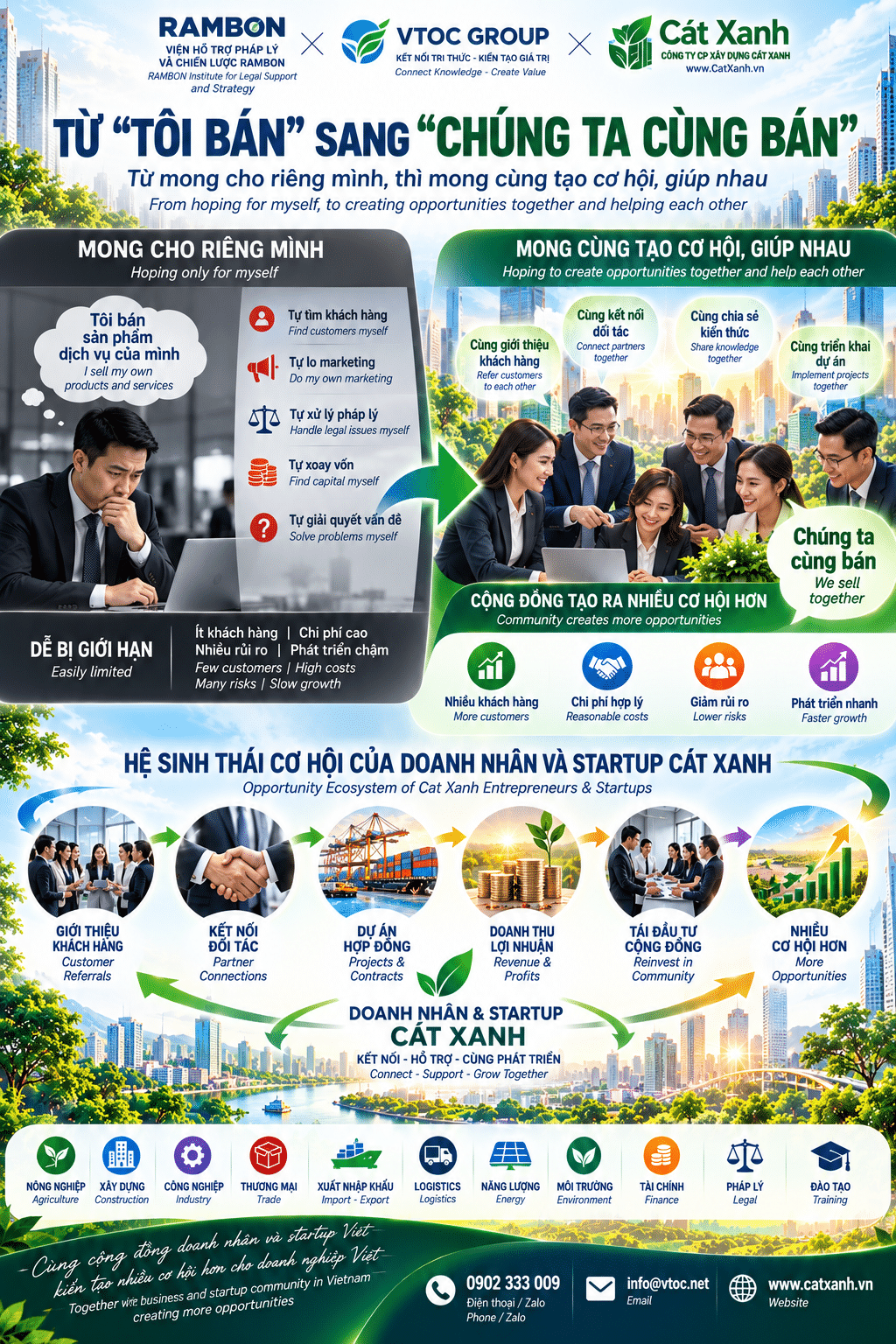
One of the biggest challenges within entrepreneurial communities is that while everyone wants to find customers for themselves, they may lack the motivation to find customers for others.
Consider these entities: Business A sells construction materials; Business B handles construction; Business C deals in real estate; Business D provides financing; and Business E offers legal services.
If each party focuses solely on its own products, the community remains nothing more than a gathering of salespeople.
However, if A refers a client to B, B introduces a project to C, C seeks a financial solution from D, D connects E for legal support, and E brings a new opportunity back to A, then the community begins to form a virtuous cycle of value creation.
This represents a shift in mindset:
From “I join this group to find customers for myself”
To “I join to create opportunities for one another.”
A strong entrepreneurial community does not necessarily require the wealthiest members; rather, it needs members who are willing to create value for each other.
The greatest divide is not between large and small enterprises, but between those who are connected and those who are left behind.
In many communities, large enterprises naturally command more attention; they possess established brands, resources, teams, and market standing.
In contrast, startups, small businesses, and individual entrepreneurs often enter these communities with significant needs but limited resources.
They need customers.
They need mentors.
They need referrals.
They need legal experts.
They need financial support.
They need help building sales systems.
They need partners for project implementation.
If a community focuses solely on those who have already succeeded, small businesses risk becoming mere “attendees” rather than genuine members of the ecosystem.
An effective model does the opposite: it empowers small businesses to grow through the community.
It is when a startup gains its first customer through the community, when a small business secures its first contract via a referral, or when an entrepreneur in crisis finds a partner to help restructure—that is when the community truly creates value.
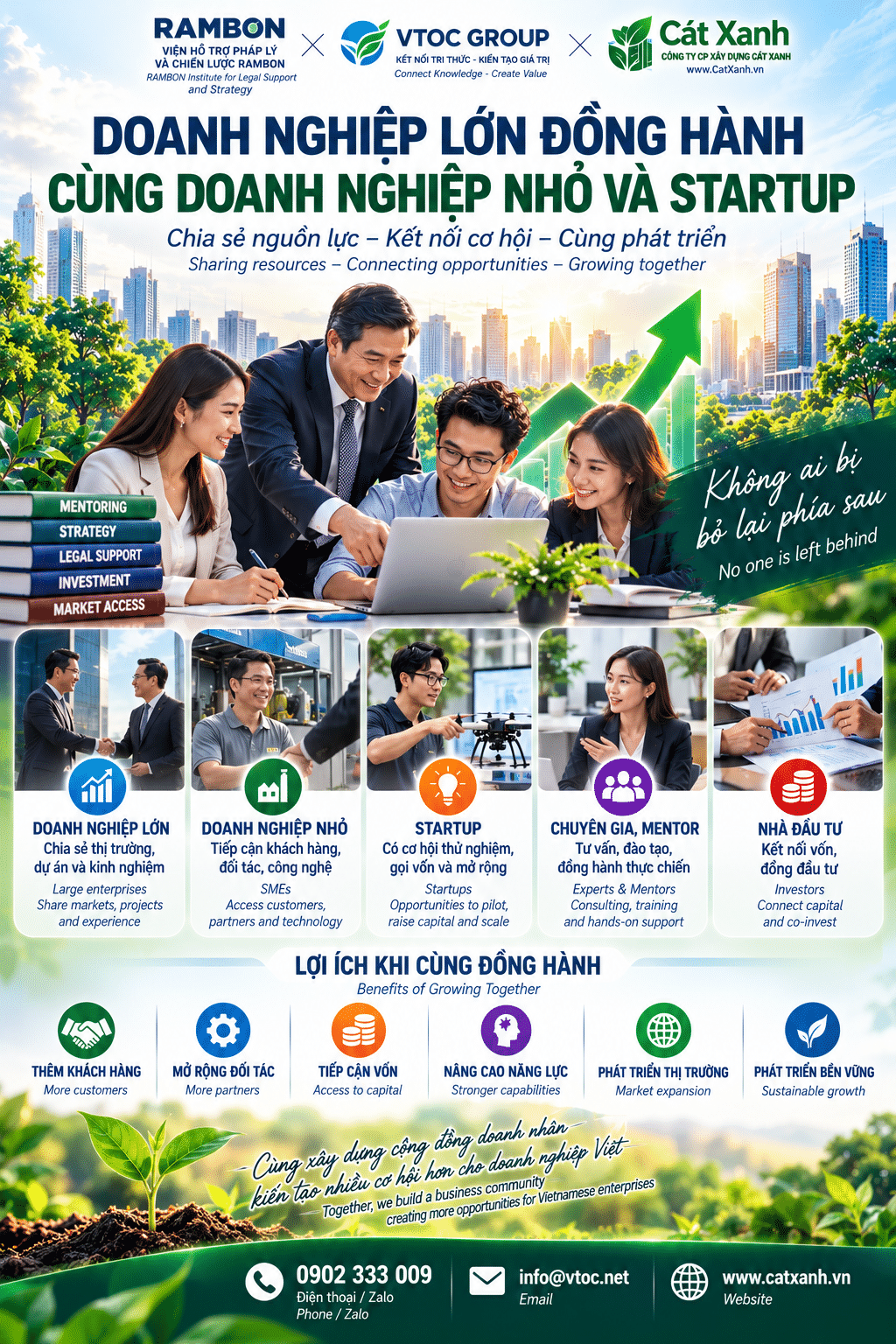
No fees for “belonging” – instead, creating value to sustain the community
A common question arises: if there are no membership fees, where do the resources for operations come from?
This is precisely where the mindset of the “Cat Xanh Entrepreneurs and Startups” model differs.
The model does not prioritize collecting money for community entry.
Instead, the mindset is focused on:
Not charging fees to form the community; rather, creating value to sustain it.
Members are not required to pay a hefty fee simply for the right to join. Specialized programs, seminars, or practical activities can be organized based on reasonable cost principles; where appropriate, participants may make small voluntary contributions to help cover organizational expenses.
The ecosystem’s economic value is generated downstream: through commercial connections, investment promotion, distribution, import-export, projects, consulting, corporate restructuring, training, startup investment, and relevant business collaborations.
When a member secures a contract, the community gains a thriving business.
When a startup receives investment and succeeds, the ecosystem gains new value.
When a business is successfully restructured, its workforce, customers, suppliers, and partners also benefit.
Therefore, resources for the community need not originate from membership fees; they can be generated from the very economic value that the community creates together.
A different economic model for the entrepreneurial community
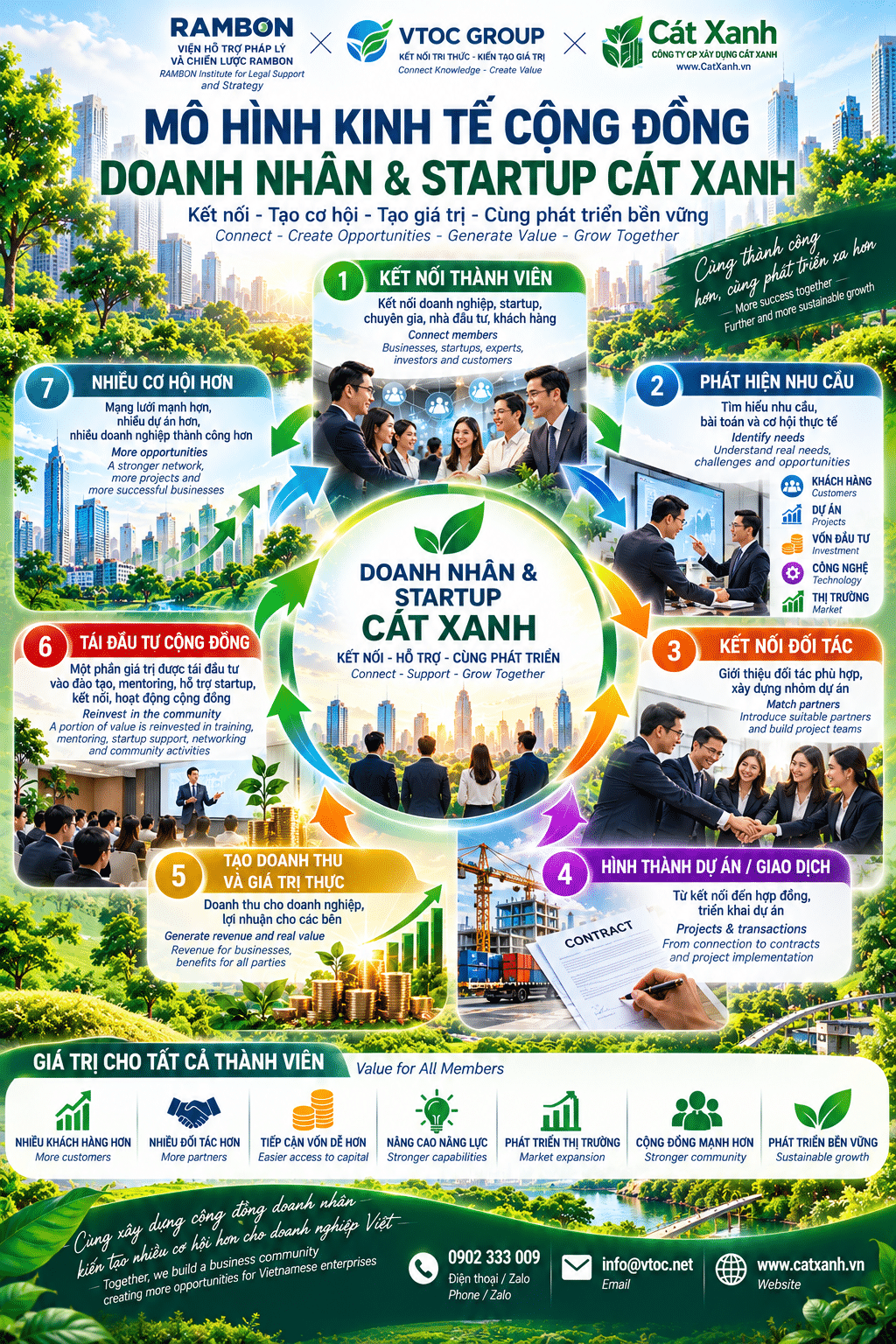
Based on this approach, “Cat Xanh Entrepreneurs and Startups” aims for a relatively simple cycle.
The community facilitates member participation with low financial barriers. The community then focuses on identifying needs and connecting customers, partners, projects, and experts.
Transactions and projects are established through appropriate contracts. A portion of the generated economic value can be reinvested into community support, training, startups, networking, and social programs.
The more successful members there are, the more resources the community possesses. With greater resources, the community is better equipped to support even more businesses.
This cycle differs from the standard model of:
Collecting fees → organizing events → seeking sponsorship → collecting more fees.
Instead, the process looks like this:
Connecting → creating opportunities → generating transactions → creating value → reinvesting in the ecosystem → creating further opportunities.
Naturally, activities such as investment, fundraising, profit distribution, lending, fund management, or transaction execution must be structured through legal entities, contracts, and mechanisms that comply with the law. The community model cannot serve as a pretext for bypassing legal requirements.
Members contribute more than just money.
Another key aspect of the model is shifting the perception of what constitutes a “contribution.”
An entrepreneur might lack significant capital but possess an excellent customer network.
Another person might have legal expertise.
Someone else might have management experience.
One person might be able to train sales teams.
Another might own a factory.
Someone might have a logistics network.
Another might have the ability to find investors.
A startup might have technology but lack market access.
A business might have customers but lack products.
If these resources are connected effectively, the community can generate value without requiring every member to contribute financially.
Some contribute capital; others contribute access to customers. Some contribute through knowledge. Others contribute through time, connections, experience, or the ability to open doors for others.
That is the essence of an ecosystem mindset.
Building trust requires frequent interaction.
Trust cannot be built through just a few meetings a year.
Trust is forged through repeated interactions: solving problems together, executing projects jointly, referring clients, keeping promises, and honoring commitments.
Therefore, a genuine community requires frequent, smaller-scale activities rather than relying solely on major events.
These could include CEO coffee chats, mentoring, coaching, business case studies, client referrals, project matchmaking, legal advice, management support, or discussions on finance, marketing, sales, HR, and investment.
The goal is not simply to organize a multitude of programs.
The goal is to provide members with practical reasons to return and continue interacting with one another.
“Doanh nhân và Startup Cát Xanh”: From a pilot model to a transferable one.
The significance of “Doanh nhân và Startup Cát Xanh” lies in more than just the fact that it is a community for entrepreneurs and startups.
Crucially, this model was researched and developed by the RAMBON Institute for Legal Support and Strategy in collaboration with the VTOC Group, based on observations of real-world challenges frequently faced by enterprises, startups, and entrepreneurial communities.
The model aims to integrate three elements that are often kept separate: community, business opportunities, and professional support capabilities.
In this framework, the community fosters a network; the network generates opportunities; opportunities lead to projects and transactions; and expertise in strategy, management, legal affairs, finance, investment, marketing, sales, and restructuring enables businesses to turn those opportunities into tangible results.
For this reason, the model was not designed as a “closed club.”
Cat Xanh Entrepreneurs and Startups are prepared to provide consulting, facilitate knowledge transfer, and partner in implementing this model for associations, business groups, clubs, entrepreneurial networks, startup communities, and organizations seeking to rebuild or upgrade their member ecosystems.
Transferring a model involves more than just handing over a set of regulations.
A community model cannot be transferred simply by providing a stack of documents.
If an association is merely given a set of bylaws, an activity plan, and a list of programs, it is highly likely to revert to its old ways after just a few months.
A true transfer of a model must encompass mindset, operational structure, value-creation mechanisms, networking tools, and implementation methods.
Everything—from defining member profiles and membership criteria to mechanisms for opportunity referrals, pipeline management, client connections, mentoring, addressing business needs, and measuring results—must be tailored to the specific community.
There is no one-size-fits-all formula.
An industry association differs from a CEO club. A startup community differs from a local business group. A long-established business association differs from a community of young entrepreneurs.
Therefore, what is transferred is not a rigid “script,” but an adaptable methodological framework.
The ultimate measure is not how many people attend an event.
A community might take pride in having thousands of members.
However, the figures that truly matter are: how many referral opportunities arise, how many connections are made, how many problems are solved, how many contracts are secured, how many startups are supported, how many businesses are improved, and how many members genuinely create value for others.

Khi đó, cộng đồng không còn được đo bằng “quy mô hội viên” mà bằng năng lực tạo ra giá trị của mạng lưới.
This is the fundamental difference between an association, society, club, or group… and an ecosystem.
From a “club for successful people” to a “community helping each other succeed.”
Perhaps one of the most significant shifts the “Cat Xanh” (Green Sand) Entrepreneur and Startup model aims to bring about is a change in perspective regarding the entrepreneurial community.
There is no need to build an association exclusively for those who have already achieved success.
Instead, let us build a community where successful individuals can share resources, those facing difficulties can find companions, startups can discover opportunities, small businesses can find customers, large enterprises can find partners, and everyone can create added value for one another.
After all, an entrepreneur’s success is measured not only by the money they earn but also by the opportunities they create for others.
The same applies to a strong community.
The strongest community is not necessarily the one with the highest number of successful individuals; rather, it is the community best equipped to help the greatest number of people achieve success.
This is the spirit driving the “Cat Xanh” Entrepreneur and Startup model—a concept researched and developed by the RAMBON Institute for Legal and Strategic Support in collaboration with VTOC Group.
It goes beyond merely creating a place for entrepreneurs to meet.
It goes beyond simply establishing a club to host events.
The goal is to build an ecosystem where every member is both a recipient and a creator of value—a place where opportunities are connected, businesses receive support, startups find companionship, and the success of one member can serve as a resource for another. If such a model proves successful in practice, the greatest value of the “Green Sand” (Cát Xanh) Entrepreneurs and Startups initiative extends far beyond the community itself.
Its greater value lies in the ability to replicate this model across other associations, clubs, and entrepreneurial groups—collectively building a generation of business communities that do not merely boast high membership numbers but truly generate significant mutual value.
If you are interested in implementing this solution for your own association, club, group, or community, please contact us at whatsapp/viber/zalo/ signal: 0902333009 or info@vtoc.net.